Accepire Insights
Compliance May 21, 20269 min read
ESG Reporting for UAE Hotels in 2026: What Every Hospitality COO Must Know Before the Deadline
Article Brief
CategoryCompliance
Read Time9 min read
PublishedMay 21, 2026
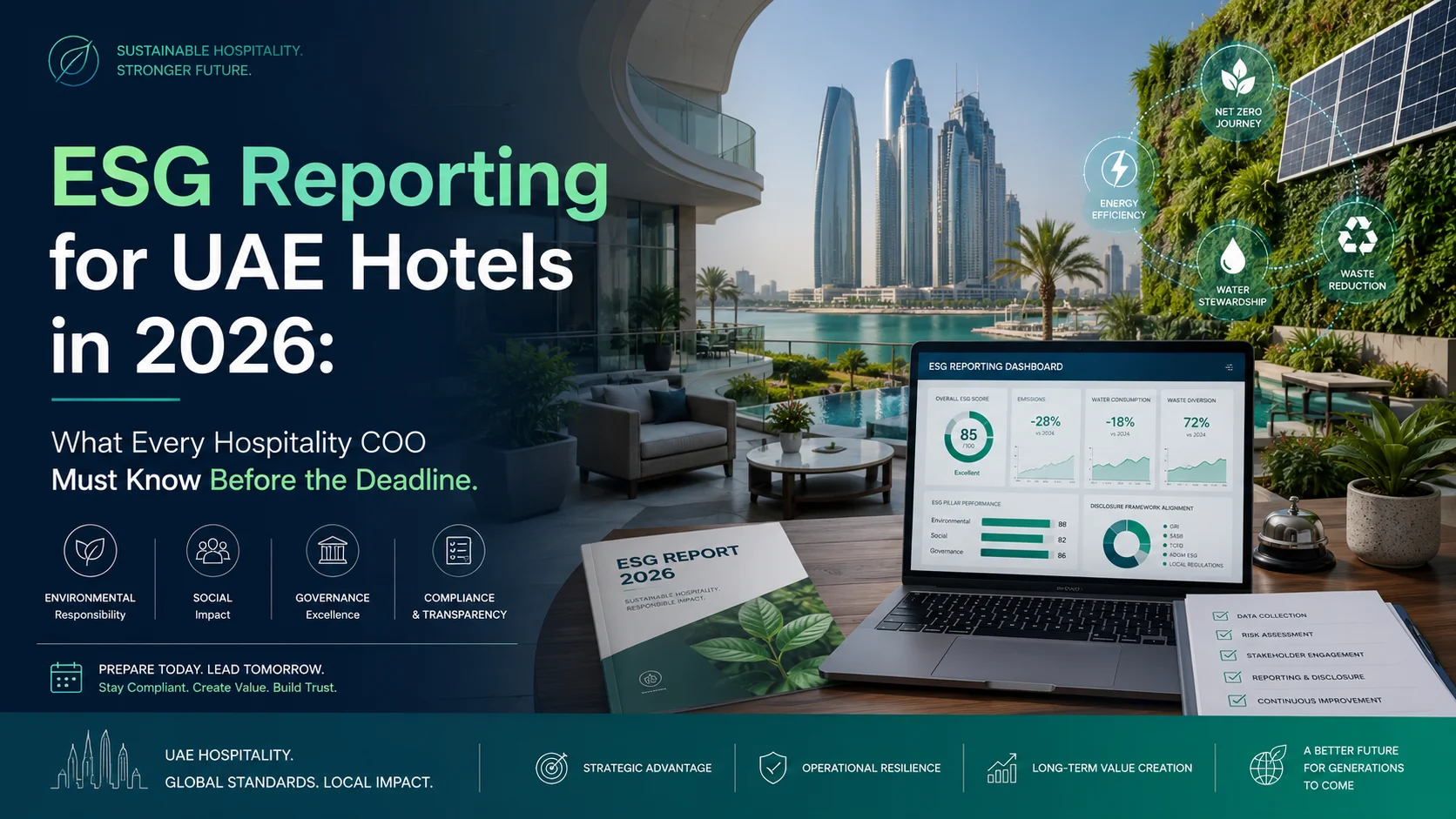
UAE's ESG deadline is 30 May 2026.
Does your hotel's data hold up to audit?
Get the Free ESG Readiness Scorecard →
Free assessment template | No sign-up required | Instant download
The UAE's new climate law is not coming. It is already in force.
Federal Decree-Law No. 11 of 2024 came into effect on 30 May 2025, making the UAE the first country in MENA to impose binding greenhouse gas obligations on every business operating within its borders with no exemptions for company size, listing status, or free zone jurisdiction.
Every hotel in Dubai, Abu Dhabi, Sharjah, and across the GCC that operates through UAE-registered entities is inside the scope of this law.
First compliance reports are due 30 May 2026.
For most hospitality COOs and operations directors, that deadline is closer than the compliance infrastructure currently in place. The gap between "we have a sustainability programme" and "we can produce audit-ready ESG evidence" is an operational problem and one that gets significantly harder to close the later you start.
This article is written specifically for operations leadership: the COO or Operations Director responsible for ensuring that when a regulator, auditor, or procurement team requests your hotel's ESG evidence, it stands up.
The Regulatory Reality Every UAE Hotel Is Now Operating Inside
Most hospitality leadership teams are aware ESG is intensifying. Fewer have mapped the complete stack of compliance obligations now converging on their operations. Here is the full picture.
Federal Decree-Law No. 11 of 2024
In force: 30 May 2025. Scope: every entity operating in the UAE that generates greenhouse gases free zone companies included, no size threshold, no exemptions. Requirements: measure and report Scope 1 and Scope 2 GHG emissions; demonstrate active reduction strategies; retain documentation for a minimum of five years, subject to regulatory audit. Penalties: AED 50,000 to AED 2,000,000 per violation. Repeat violations within two years: penalties double to AED 4,000,000.
DFM and ADX Listed Hotel Groups
Mandatory ESG disclosure has been in force for Dubai Financial Market listed companies since FY2023. Required metric categories include: total waste generated, waste diverted from disposal, energy consumption by source, water usage, Scope 1 and 2 emissions, and workforce composition. Reports are filed alongside annual financial statements. The Abu Dhabi Securities Exchange runs a parallel framework with equivalent scope.
GCC Regional Obligations
Saudi Arabia's Capital Market Authority is advancing ESG disclosure guidelines as part of Vision 2030. Qatar's Financial Centre has proposed ISSB-aligned reporting from January 2026 Premier Market companies must report FY2025 data by June 2026. Oman and Bahrain are both transitioning from voluntary to mandatory frameworks. For hotel groups with properties across multiple GCC markets, this is not a UAE-only compliance exercise.
European Supply Chain Requirements
Hotel brands and investment vehicles with European ownership structures face the EU Corporate Sustainability Reporting Directive (CSRD) and Corporate Sustainability Due Diligence Directive (CSDDD), which require verification of ESG practices across the full supply chain including UAE and GCC properties. If your hotel operates under a management agreement, franchise, or investment structure with European exposure, your sustainability data is already a condition of that commercial relationship.
The compliance stack has converged. The question is no longer whether your hotel needs auditable ESG data. It is whether you can produce it.
The Difference Between an ESG Programme and Audit-Ready ESG Evidence
This distinction is where most hospitality operations currently stand exposed.
Most UAE hotels have some version of a sustainability programme. Waste disposal is tracked with vendors. Energy is logged. Monthly summaries are compiled. Sustainability managers produce annual reports. None of that is audit-ready in the sense that regulators and procurement teams now require.
When a Ministry of Climate Change and Environment auditor or a procurement officer running an ESG qualification process requests evidence of your waste diversion performance, they are not looking for a summary document. They are applying a specific evidence standard.
Five Criteria Your ESG Data Must Now Meet
Timestamped event records. Not a monthly aggregate. A discrete, traceable log of each disposal event: what material, what quantity, which property, confirmed at what time, by which party.
Chain-of-custody documentation. Verifiable proof that material moved from your property through each transfer point - hauler, intermediate facility, recycler or disposal site with a confirmed record at every handoff. A vendor invoice confirms a transaction. It does not confirm what happened to the material downstream.
Independent checkpoint confirmation. Is the evidence self-reported by your team, or does it include third-party or IoT confirmation at the point of transfer? Unconfirmed self-reporting is treated as a material weakness in both regulatory audits and procurement qualification.
Framework-mapped export formats. Can your evidence pack be structured against DFM ESG disclosure categories, GRI waste standards, or CSRD supply chain requirements, rather than an internally formatted PDF that auditors must manually interpret?
Multi-property aggregation. For groups with properties across Dubai, Abu Dhabi, Riyadh, and Doha, can verified data be consolidated into a single compliance view without repeating the evidence collection process for each location and each audit cycle?
If your current ESG process cannot satisfy all five, it is not audit-ready. It is audit-vulnerable and under UAE law, that is now a quantified financial risk.
Find out exactly where your compliance gaps are.
Get the ESG Readiness Scorecard free assessment template + property-level implementation checklist.
Where Hotel ESG Programmes Quietly Break Down
Operations teams are not the problem. The problem is an evidence architecture that was never designed for the standard now being applied.
Fragmented vendor records. Waste disposal data lives across multiple haulers in multiple formats: some PDF, some emailed manifest, some verbal confirmation. There is no unified event log. At month end, someone manually reconciles what they can find. What they produce is a summary. What an auditor requires is a trail.
Self-reported metrics without verification. Team members estimate quantities. Vendors summarise in formats convenient to them. No independent checkpoint confirms that what was reported at the hotel matches what was received at the recycling facility. In audit terms, this is the weakest form of evidence for a claim without proof.
No chain-of-custody. Your team knows approximately how much waste left the property. There is no verified record of where it went, who handled it, and what was confirmed at each transfer point. Under Federal Decree-Law No. 11 of 2024 and DFM disclosure requirements, that distinction is now legally and commercially material.
Audit preparation as a separate crisis. Every time a compliance report, RFP sustainability questionnaire, or DFM ESG filing comes around, your team spends weeks chasing vendors, reconciling conflicting figures across properties, and assembling documents that are approximately accurate but not independently verifiable.
Siloed data across a multi-property group. A hotel group with eight properties across UAE and GCC has eight separate, disconnected data collection processes. The corporate ESG team aggregates manually. The result is consolidated data not chain-of-custody evidence.
This is the operational reality for most hospitality businesses in the region right now. It is also exactly the problem AxiomFlow solves.
AxiomFlow: From Audit-Vulnerable to Audit-Ready in Four Weeks
AxiomFlow, developed by Accepire, is an ESG compliance platform built specifically for hospitality and operations teams that need defensible ESG reporting, not documentation that looks credible until it is challenged.
The core architecture replaces fragmented vendor records, manual spreadsheet aggregation, and retroactively assembled audit packs with a verified, timestamped, chain-of-custody evidence system built on QR-based event capture and tamper-resistant verification checkpoints.
The Operational Workflow:Three Steps
Capture at Source. At the point of waste generation, kitchen, F&B outlet, housekeeping, back-of-house disposal events are tagged using QR codes linked to site metadata. Each event is recorded automatically: material type, quantity, property, timestamp, confirming party. No manual data entry. No retrospective estimation.
Verify Through the Chain. As material moves from your property through haulers to recycling or disposal facilities, each transfer is validated through tamper-resistant checkpoints. The chain of custody builds in real time, every handoff logged, every party confirmed, every discrepancy flagged before it becomes an audit finding.
Report with Confidence. When your UAE Climate Law compliance deadline arrives, your DFM ESG disclosure is due, or a European procurement partner requests sustainability data, AxiomFlow generates structured evidence packs. Full chain-of-custody record, timestamped event log, metric outputs pre-mapped to DFM, GRI, and CSRD alignment. Exported in hours, not assembled over weeks.
The Operational Shift → Before and After
| Before AxiomFlow | After AxiomFlow |
|---|---|
| Monthly chase for updated vendor manifests | Events auto-captured at point of generation |
| Manual reconciliation across properties | Multi-property data consolidated centrally |
| Self-reported estimates, no third-party confirmation | Chain-of-custody confirmed at every handoff |
| Audit prep takes 3–4 weeks per cycle | Evidence packs exported in hours |
| Framework mapping done manually each period | Outputs pre-mapped to DFM, GRI, CSRD |
| ESG claims defensible to a point | Every claim traceable to a verified event |
Why UAE and GCC Hotel Groups Are Acting Before the Deadline
Compliance pressure alone would be sufficient. But three commercial dynamics are making this a business priority not just a legal one.
Enterprise procurement has become an ESG filter. Across UAE government-linked entities, regional conglomerates, and international hotel management companies, RFPs now include ESG qualification criteria. Hotels that cannot provide verified sustainability performance data are progressively excluded from high-margin corporate, MICE, and government-contract segments not because their operations are poor, but because their evidence is unverifiable. EcoVadis, the global supplier ESG rating platform required by an increasing number of multinationals, evaluates vendors on waste management and environmental reporting. No verifiable ESG record means no EcoVadis rating. No EcoVadis rating means no tender in a growing share of global procurement processes.
ESG-linked financing has become a competitive pricing differential. UAE banks have begun integrating ESG scoring into lending and refinancing decisions. Green finance instruments and sustainability-linked loans expanding rapidly in both volume and rate competitiveness across the region require credible, independently verifiable ESG track records. Self-declared data does not qualify. For hotel groups navigating refinancing, development financing, or sustainability-linked debt issuance, a verified evidence trail built over time through AxiomFlow is a direct financial asset at the term sheet table.
Greenwashing exposure is no longer theoretical. The EU's Green Claims Directive, Dubai DET's evolving hotel classification sustainability requirements, and a measurably more ESG-literate corporate travel buyer base are all converging on the same outcome: unverified sustainability marketing is transitioning from a credibility question to a legal and commercial liability.
The risk arithmetic has changed for hospitality COOs. Building verified ESG evidence capability before the deadline is cheaper, faster, and lower-risk than assembling a compliance response after one.
AxiomFlow Across the GCC Designed for the Region
AxiomFlow is developed and operated by Accepire, a cloud engineering and software company with an established UAE and GCC market presence, building PDPL-compliant, cloud-native systems for Middle East enterprise. Unlike generic ESG platforms designed for Western reporting frameworks, AxiomFlow's architecture and export formats are aligned to the specific disclosure requirements hospitality COOs are navigating across the region.
UAE
Architecture aligned with Federal Decree-Law No. 11 of 2024 GHG reporting requirements and DFM mandatory ESG disclosure categories. Cloud infrastructure deployable within UAE data residency boundaries (AWS Middle East UAE / Azure UAE regions) for full PDPL compliance. Data never leaves the region.
Saudi Arabia
As Vision 2030 ESG expectations intensify and the CMA advances green finance frameworks, AxiomFlow's verifiable evidence packs position hotel groups for both regulatory alignment and investor-grade disclosure including multi-market groups operating across UAE and KSA from a single platform instance.
Qatar
With QFC ISSB-aligned reporting proposed from January 2026 and Premier Market FY2025 disclosures due June 2026, AxiomFlow's structured export capabilities give Doha-based operations a repeatable compliance workflow that does not require rebuilding the evidence stack each reporting cycle.
Multi-Market GCC Groups
AxiomFlow's architecture is centralised, multi-property reporting a single compliance view across multiple countries, vendor networks, and regulatory frameworks. For hotel groups operating across UAE, KSA, Qatar, and beyond, this replaces disconnected, manually reconciled, property-level reporting.
Implementation What Four Weeks to Audit-Ready Looks Like
No new hardware is required. No major operational disruption.
Weeks 1–2 Discovery and Mapping
Waste stream mapping, vendor relationship audit, and evidence gap assessment across enrolled properties. You receive a documented picture of exactly where your current compliance posture is vulnerable.
Weeks 3–4 Capture Deployment
QR-based event capture deployed at priority waste generation points. Operations team onboarded. First verified events captured and logged. Chain-of-custody verification activated across hauler and facility checkpoints.
Weeks 5–8 Baseline and Verification
Verified dataset for the reporting period established. Multi-property aggregation active in the compliance dashboard.
Week 9+ Continuous Audit Readiness
First evidence pack exportable. Ongoing capture running automatically across all enrolled properties. Framework-mapped outputs available on demand for DFM, GRI, CSRD, and custom audit requirements.
The platform begins with QR and process controls. IoT sensor integrations are added as the compliance programme matures.
Frequently Asked Questions
Yes. Federal Decree-Law No. 11 of 2024 applies to every entity operating in the UAE that generates greenhouse gases. There are no exemptions for free zone companies and no exemptions based on company size or listing status. The law came into force on 30 May 2025. First compliance reports are due 30 May 2026.
The Window Before the Deadline Is Closing
Evidence systems take time to establish a verifiable baseline. A hotel group that begins deploying AxiomFlow now will have a complete, defensible evidence trail covering the full reporting period before the 30 May 2026 compliance deadline. A group that begins in April will be filing a compliance response built on an incomplete dataset and managing the audit risk that comes with it.
The difference between those two outcomes is not intention, investment, or operational commitment. It is lead time.
UAE and GCC hospitality operations that close their ESG evidence gap now do not just satisfy the regulatory requirement. They build the verified track record that unlocks ESG-linked financing, qualifies them for procurement processes that are already applying ESG filters, and produces the defensible brand asset that turns sustainability performance into commercial differentiation.
The COOs acting before this deadline are not being commercially precise.
Know where your ESG gaps are before an auditor does.
Benchmark against the 5 audit criteria UAE regulators apply
Identify exact compliance gaps by property
Free assessment template + implementation checklist
No cost - No sign-up - Takes 15 minutes
Ready to see AxiomFlow in your operational context? Book a 20-minute technical fit call →
Available for UAE, KSA, Qatar, and GCC-based hospitality operations.
AxiomFlow is a product of Accepire - custom software and cloud engineering for UAE and GCC enterprise. Microsoft Partner. PDPL-compliant infrastructure. Serving hospitality, fintech, and healthcare sectors across the Middle East.
See AxiomFlow live at axiomflow.accepire.com
Published May 2026 · View all insights