Accepire Insights
Software Dev April 7, 202611 min read

Build vs Buy Software: A Decision Framework for 2026

Article Brief
CategorySoftware Dev
Read Time11 min read
PublishedApril 7, 2026
AE
Accepire Engineering
Software Specialists @ Accepire
April 7, 202611 min read
Build vs Buy Software: A Decision Framework for 2026

Executive Summary

"This guide provides a practical framework for the build vs buy decision. We cover the hidden costs of both approaches, when each makes sense, and include a detailed 5-year TCO comparison with real numbers."
Accepire Engineering

About the Author

Expert

Software Specialists @ Accepire

Our engineering team consists of senior developers, cloud architects, and AI specialists with expertise in React, Node.js, Go, Rust, and cloud platforms (AWS, Azure, GCP). We collectively bring 50+ years of experience building scalable software systems.

Why "What's Cheaper?" Is the Wrong Question

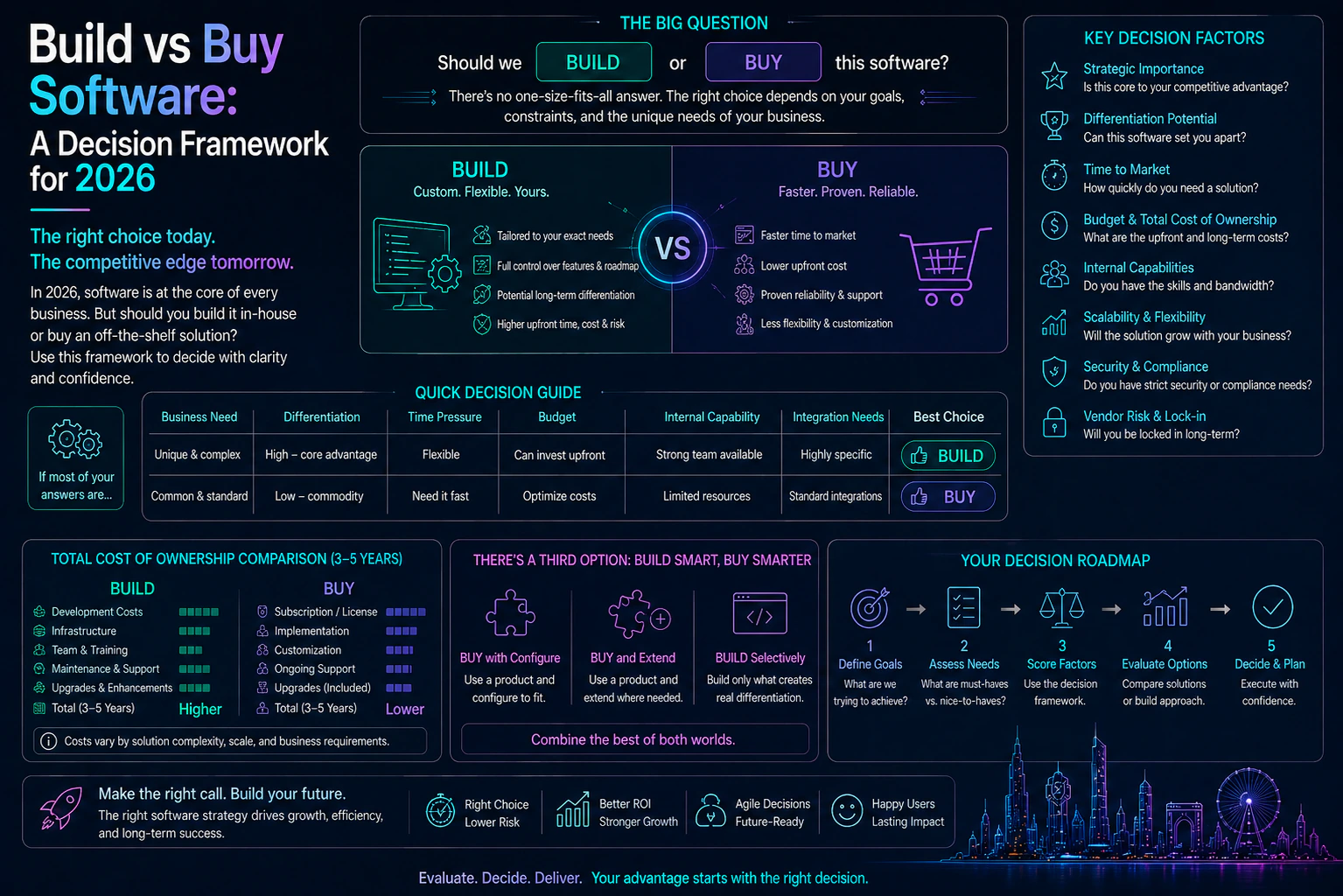
Most build vs buy comparisons focus on cost. They calculate the monthly SaaS subscription against the development estimate and declare a winner. This is fundamentally wrong.

The right question isn't "what's cheaper?" It's "what creates competitive advantage?" Amazon didn't build AWS because it was cheaper than renting servers—they built it because infrastructure was core to their business.

For commodity functions (email, accounting, basic CRM), buying almost always wins. For functions that differentiate your business, building is often worth the investment.

The Three Questions That Actually Matter

1. Is This a Competitive Differentiator?

If the process you're automating is central to how you win in the market, building custom gives you advantages competitors can't easily copy. If it's a support function that every business needs, buy the commodity solution.

2. How Unique Are Your Requirements?

If 80% of an off-the-shelf tool fits your needs, the 20% customization probably isn't worth building from scratch. But if you're forcing your workflow into an ill-fitting tool and spending hours on workarounds, custom might save time in the long run.

3. What's the True Total Cost of Ownership?

This is where most analyses fail. They compare subscription costs to development costs without accounting for all the hidden costs on both sides.

Hidden Costs of Buying

What the SaaS Subscription Doesn't Include:

  • Per-User Scaling: That $50/user/month adds up fast. 100 users = $60,000/year, forever.
  • Integration Work: Connecting to your other systems often requires custom development anyway.
  • Workflow Adaptation: Training costs and productivity loss from forcing your process into the tool's structure.
  • Feature Gaps: Building workarounds for missing features, or paying for premium tiers you barely use.
  • Vendor Lock-in: Switching costs grow over time as data and workflows become entrenched.
  • Price Increases: SaaS vendors raise prices. Your renewal in year 3 won't be the same as year 1.

Hidden Costs of Building

What the Development Estimate Doesn't Include:

  • Ongoing Maintenance: Budget 15-20% of initial cost per year for updates, security patches, and bug fixes.
  • Feature Evolution: Your needs will change. Plan for ongoing development, not a one-time build.
  • Knowledge Management: Documentation, training, and managing knowledge transfer when team members change.
  • Infrastructure Costs: Hosting, monitoring, backups, and scaling as usage grows.
  • Opportunity Cost: Engineering resources spent on internal tools aren't building customer-facing products.

When to Definitely BUY

  • Commodity Functions: Email, calendar, basic CRM, accounting, HR systems. Everyone needs these, and off-the-shelf is better than you'd build.
  • Regulated/Compliance Areas: Payroll, tax, certain financial functions. Let specialists handle the compliance burden.
  • Your Requirements Match 80%+: If a tool mostly fits, customize around the edges rather than rebuilding.
  • You Need It Yesterday: SaaS deploys in days. Custom takes months. Sometimes speed trumps perfection.

When to Definitely BUILD

  • Core Competitive Advantage: If the process IS your product or creates differentiation, own it.
  • Unique Workflow Requirements: When off-the-shelf tools force painful workarounds that waste hours weekly.
  • Scale Economics Favor Building: High user counts make per-seat licensing expensive fast.
  • Integration Is Central: When you need deep integration with proprietary systems that SaaS tools don't support.
  • Data Sensitivity: When you need complete control over where and how data is stored and processed.

5-Year TCO Comparison: Real Numbers

Let's look at a real scenario: A 50-person company needs a custom workflow management system.

Cost Category Buy (SaaS) Build (Custom)
Year 1: Setup/Development $15,000 (implementation + training) $75,000 (development)
Year 1: Subscription/Hosting $60,000 ($100/user x 50 x 12) $12,000 (cloud hosting)
Years 2-5: Ongoing Costs $288,000 ($72K/yr with 5% increases) $108,000 ($15K maintenance + $12K hosting x 4)
Integration Work $40,000 (custom connectors) $0 (built into development)
Productivity Loss (workarounds) $50,000 (estimated over 5 years) $0 (built to your workflow)
5-Year Total $453,000 $195,000

In this scenario, building custom saves $258,000 over 5 years—and you own the asset at the end. But note: this math only works because the team size is large enough and the workflow is unique enough to justify custom development.

"The break-even point for build vs buy typically happens around 30-50 users for workflow-heavy applications. Below that, SaaS usually wins. Above that, run the numbers carefully."

Let's Run Your Numbers

Every situation is different. Book a free consultation and we'll help you calculate the real TCO for your specific use case—build vs buy, with honest numbers.

Get Your Custom TCO Analysis →

Frequently Asked Questions

Most custom software projects achieve ROI within 12-24 months, primarily through operational efficiency gains, reduced manual labor, and competitive advantages. The exact timeframe depends on your specific use case and the inefficiencies being solved.
Next Steps

Ready to implement Software Dev in your business?

We provide custom software development and cloud engineering services tailored to your specific technical and business needs.

Microsoft for Startups Founders Hub Member