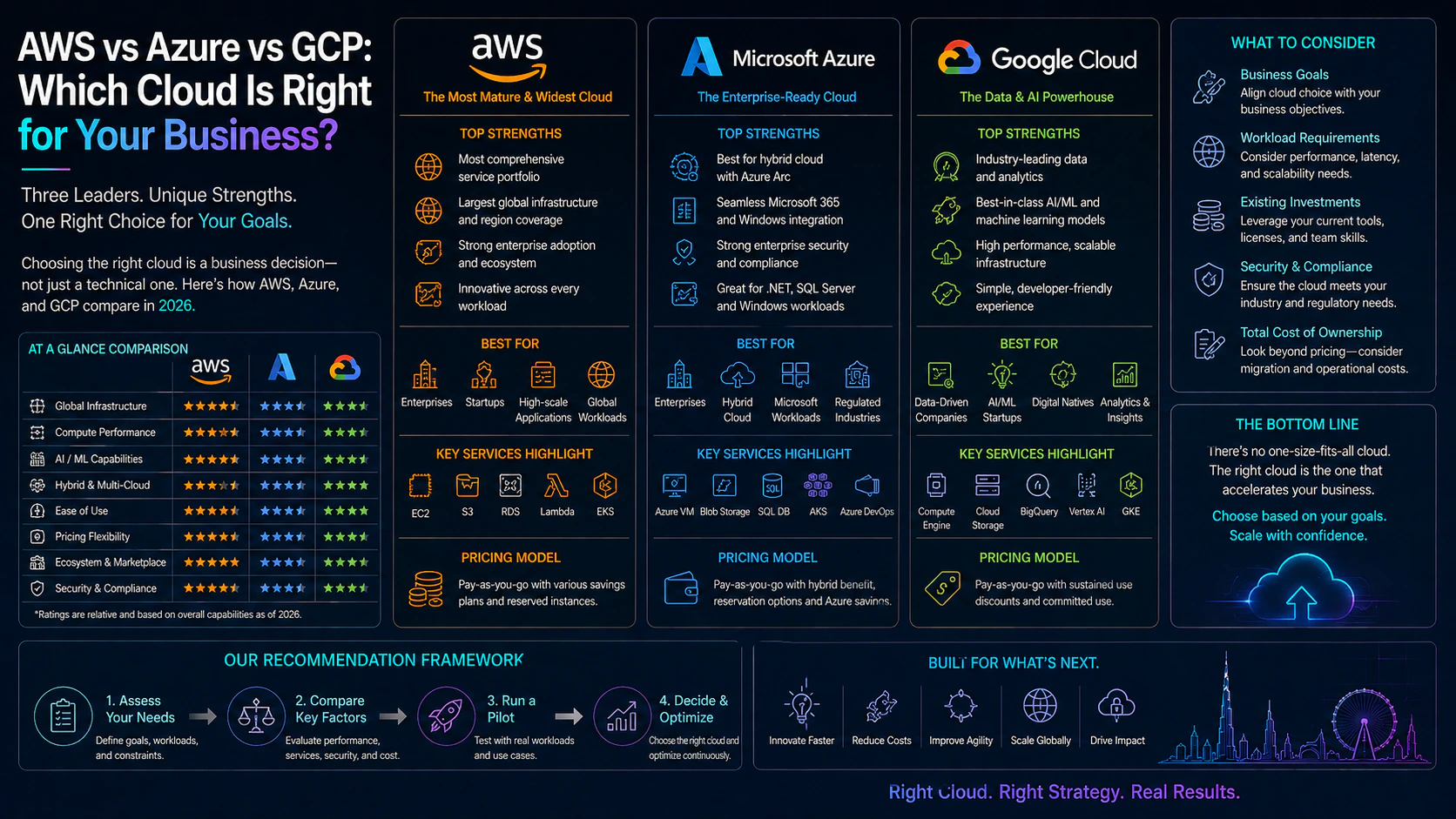
Quick Comparison Table
| Factor |
AWS |
Azure |
GCP |
| Market Share |
~32% (Leader) |
~23% |
~10% |
| Best For |
Breadth of services, startups |
Microsoft shops, enterprises |
Data/ML, Kubernetes-native |
| Strengths |
Mature ecosystem, most services |
Enterprise integration, hybrid |
AI/ML, BigQuery, GKE |
| Weaknesses |
Complex pricing, console UX |
Naming confusion, documentation |
Smaller ecosystem, enterprise features |
| Pricing Model |
Per-second billing |
Per-minute billing |
Per-second, sustained discounts |
When to Choose AWS
AWS is the default choice for a reason: it has the most services, the most mature ecosystem, and the largest talent pool. If you're unsure, AWS is rarely wrong.
Choose AWS When:
- You're a startup: AWS Activate offers up to $100K in credits, and most developers already know AWS.
- You need specific services: AWS has the widest selection-if a managed service exists, AWS probably has it.
- You're hiring: More developers know AWS than any other cloud, making hiring easier.
- You need global reach: AWS has the most regions worldwide, important for latency-sensitive applications.
AWS Standout Services:
- • Lambda: The original serverless compute, still the most mature
- • DynamoDB: Unmatched for high-scale NoSQL
- • S3: The gold standard for object storage
- • EKS: Solid managed Kubernetes (though GKE edges it out)
When to Choose Azure
Azure makes sense when you're already in the Microsoft ecosystem. The integration with Active Directory, Office 365, and .NET is unmatched.
Choose Azure When:
- You're a Microsoft shop: If you use Active Directory, Office 365, or .NET, Azure integrates seamlessly.
- You need hybrid cloud: Azure Arc and Azure Stack are best-in-class for hybrid deployments.
- Enterprise procurement: Many enterprises have existing Microsoft agreements that make Azure cheaper.
- You're in regulated industries: Azure has strong compliance certifications and government cloud offerings.
Azure Standout Services:
- • Azure AD: Enterprise identity management, period
- • Azure DevOps: Excellent CI/CD integrated with GitHub
- • Power Platform: Low-code tools that integrate with everything Microsoft
- • Azure OpenAI Service: GPT-4 with enterprise security and compliance
When to Choose Google Cloud
GCP is the underdog with genuine advantages in specific areas. If you're doing serious data work or want the best Kubernetes experience, GCP deserves consideration.
Choose GCP When:
- Data is your core business: BigQuery is genuinely better than Redshift or Synapse for analytics at scale.
- You're Kubernetes-native: GKE is the best managed Kubernetes-Google invented K8s.
- ML/AI is central: TensorFlow, Vertex AI, and TPUs give GCP an edge in machine learning.
- You value developer experience: GCP's console and CLI are more intuitive than AWS's.
GCP Standout Services:
- • BigQuery: Serverless data warehouse that just works
- • GKE: The best managed Kubernetes experience
- • Cloud Run: Serverless containers done right
- • Vertex AI: Comprehensive ML platform
The Cost Reality Check
Here's the truth: cloud pricing is deliberately complex, and "which is cheapest" depends entirely on your workload.
"We've seen identical workloads cost 40% more or less depending on the cloud provider-and on how the architecture was designed. The provider matters less than the architecture."
Cost Optimization Tips (Any Cloud):
- Right-size instances: Most companies over-provision by 40%+. Start small, scale up.
- Use reserved capacity: Commit to 1-3 years for 30-60% savings on predictable workloads.
- Spot/preemptible for batch: 60-90% savings for interruptible workloads.
- Monitor egress: Data transfer out is where clouds make real money. Architect to minimize it.
Decision Framework: 5 Questions to Ask
1. What's your existing tech stack?
Microsoft shop → Azure. Otherwise → AWS or GCP based on other factors.
2. What does your team know?
The cloud your team knows is often the right choice. Learning curves cost money.
3. What specific services do you need?
Need BigQuery-level analytics → GCP. Need Lambda-style serverless → AWS. Need Azure AD integration → Azure.
4. Where are your users?
Check which provider has regions closest to your users. Latency matters.
5. What's your growth trajectory?
Startups should prioritize developer velocity and credits. Enterprises should prioritize compliance and support.
Need Help Choosing?
We've architected systems on all three major clouds. Book a free cloud architecture review and we'll recommend the right platform for your specific needs-no vendor bias.
Get a Free Cloud Architecture Review →
For a company already running Azure, an Azure Cost & Reliability Audit assesses the cost, architecture, and reliability evidence before a change.