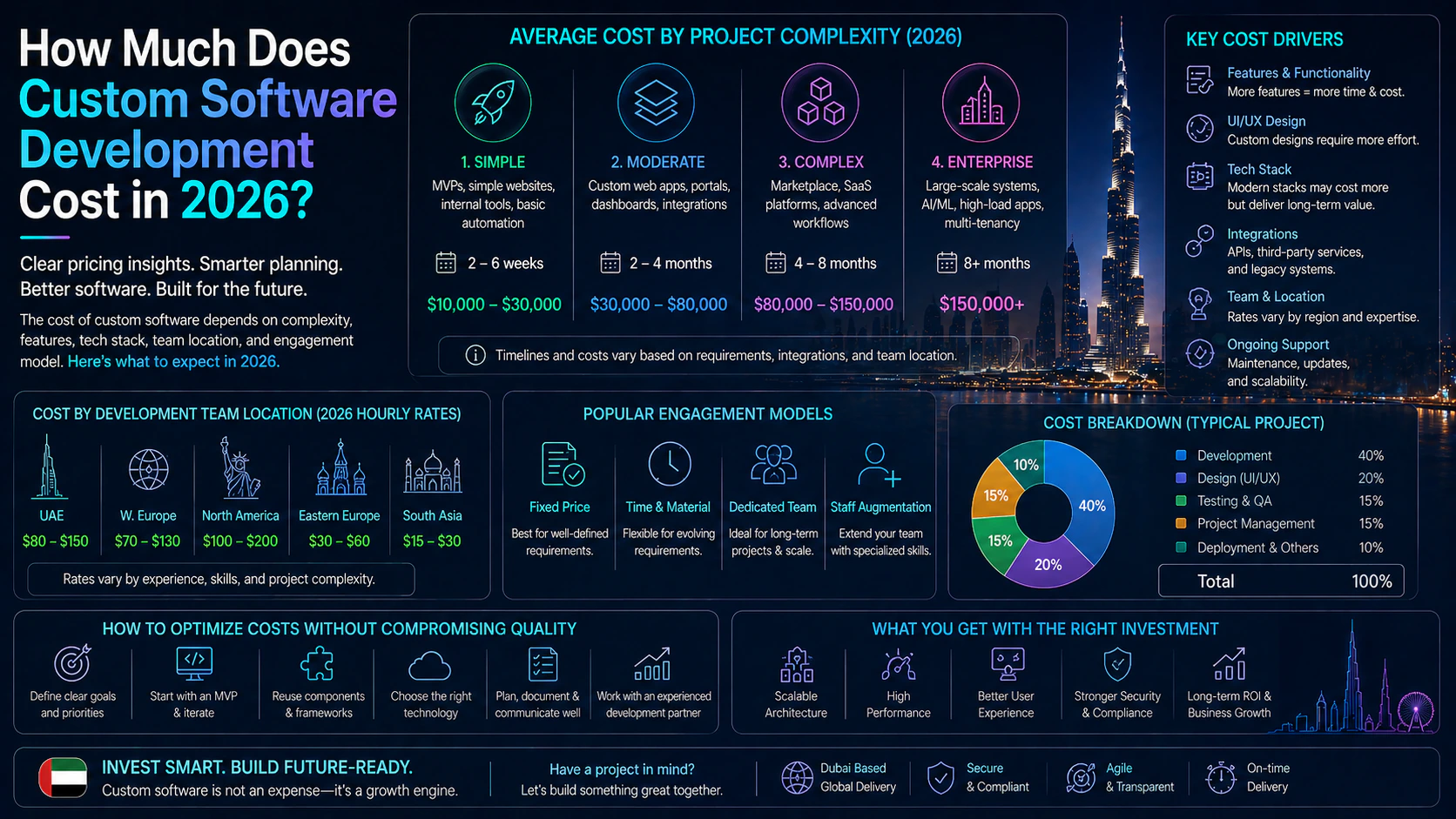
Why Most Quotes Are Frustratingly Vague
You've probably experienced this: You describe your project to a development agency, and they respond with "it depends" followed by a range so wide it's useless. "$20,000 to $200,000 depending on requirements." Thanks for nothing.
Here's why this happens: Most agencies use vague quotes as a sales tactic. They lowball to get you in the door, then pile on change orders once you're committed. Others genuinely don't know because they haven't done the upfront work to understand your project.
At Accepire, we believe you deserve better. After building 5+ products and serving 50K+ users across our platforms, we've developed a clear understanding of what things actually cost. Let's break it down.
The 6 Factors That Determine Your Cost
1. Complexity of Core Features
A simple CRUD application (create, read, update, delete) is fundamentally different from a real-time collaboration platform. The more complex your business logic, the more engineering time required. Features like real-time sync, complex calculations, multi-tenant architecture, or AI integration significantly increase costs.
2. Number and Complexity of Integrations
Every third-party integration adds development time. A Stripe integration might take a day. A full ERP integration could take weeks. We've seen projects where integrations accounted for 40% of the total budget. Be realistic about what you need to connect.
3. Design and User Experience Requirements
A functional admin panel is different from a consumer-facing product that needs to delight users. Custom animations, complex data visualizations, and pixel-perfect design all add to the investment. Decide early: are you building a tool or an experience?
4. Compliance and Security Requirements
Building for healthcare (HIPAA)? Financial services (PCI-DSS)? Government contracts (FedRAMP)? Compliance requirements can double your architecture complexity. Security audits, penetration testing, and documentation all add to the bottom line.
5. Timeline Pressure
Need it in 4 weeks instead of 12? Accelerated timelines require larger teams working in parallel, which increases coordination overhead and cost. Rush jobs typically cost 30-50% more than projects with reasonable timelines.
6. Team Composition and Location
A US-based senior team costs more than an offshore junior team-but they also ship faster with fewer bugs. We've seen "cheap" offshore projects cost 3x the original quote after two failed attempts. You get what you pay for.
Real Price Ranges by Project Type
MVP / Proof of Concept
$599 - $1,499
Timeline: 6-12 weeks
- • Core functionality only (3-5 key features)
- • Basic but functional UI/UX
- • Single platform (web OR mobile)
- • 1-2 essential integrations
- • Deployment and basic monitoring
Full SaaS Platform
$1,599 - $2,999
Timeline: 3-6 months
- • Complete feature set with user management
- • Multi-tenant architecture
- • Payment processing and subscriptions
- • Admin dashboard and analytics
- • Multiple integrations (5-10)
- • Responsive web + mobile considerations
Enterprise Platform
$4,999 - $8,999+
Timeline: 6-12 months
- • Complex business logic and workflows
- • Enterprise security and compliance (SOC2, HIPAA)
- • Advanced integrations (ERP, legacy systems)
- • High availability architecture (99.99% uptime)
- • Multiple user roles and permissions
- • Comprehensive documentation and training
Hourly vs Fixed-Price: Which Model Wins?
The Case for Hourly
Hourly billing works when requirements are genuinely unknown-like R&D projects or ongoing maintenance. You pay for time spent, which can be efficient when scope is fluid. However, it creates a misaligned incentive: the agency makes more money the longer things take.
The Case for Fixed-Price
Fixed-price quotes work when you know what you're building. You get budget certainty, the agency is incentivized to be efficient, and there are no surprise invoices. The catch: you need a well-defined scope upfront, and changes cost extra.
Our Recommendation
For most projects, fixed-price is better. It forces both sides to do the hard work of defining scope upfront, which leads to better outcomes. At Accepire, we spend significant time on discovery before quoting-so when we give you a number, it's real.
Red Flags That Signal Budget Disaster
🚩 The Quote Is Suspiciously Low
If one agency quotes $20K and everyone else quotes $80K, the $20K agency either doesn't understand the project or is planning to hit you with change orders. We've rescued multiple projects from "cheap" agencies that ended up costing clients 3x the original budget.
🚩 No Discovery Phase
Any agency that quotes without asking detailed questions is guessing. A proper quote requires understanding your business, users, technical constraints, and success criteria. If they skip this, run.
🚩 Vague Scope Documents
"User authentication" can mean a simple login form or a complex SSO integration with MFA. If the scope document doesn't specify, you'll pay for the ambiguity later. Good agencies write detailed specifications.
🚩 No Mention of Testing or QA
If testing isn't in the quote, bugs aren't in the budget. You'll either pay for them later or ship broken software. Testing should be 20-30% of total development time.
Why We Use Fixed-Price Quotes
At Accepire, every project gets a fixed-price quote after a thorough discovery phase. Here's why:
- Budget Certainty: You know exactly what you're paying before we write a line of code.
- Aligned Incentives: We make money by being efficient, not by dragging things out.
- Forced Clarity: The fixed-price model requires us to understand your project deeply upfront.
- No Surprises: What you're quoted is what you pay (within the agreed scope).
We work in 2-week sprints with regular demos. If you're not satisfied after the first sprint, you can walk away with the code we've written-no penalties. That's how confident we are in our process.
Ready for a Real Quote?
Stop guessing what your project will cost. Book a free discovery call with our engineering team and get a detailed, fixed-price proposal within 48 hours.
Book Your Free Discovery Call →
Whatever the build costs, the cloud bill runs for the life of the system. For Azure estates, an Azure Cost & Reliability Audit establishes whether the running cost matches the workload.